6 factors to evaluate before signing an embedded lending partner
Team Parafin
There are two ways small businesses earn revenue: by selling goods and services, or by securing capital to fund what comes next. Platforms that serve small businesses have spent the last decade solving the first through payments. The second is where the next wave of platform value is being built, and it's why embedded lending is increasingly part of the roadmap conversation.
The decision on whether to offer it tends to be straightforward. The decision on who to build it with is where platforms can struggle, and where the long-term success of the program are actually decided.
This guide is for platform teams in the middle of that evaluation. The six factors below are what separate programs that simply launch from programs that become a net new revenue driver and a key retention lever. A fast integration and a clean demo will get you to market, but they don't drive meaningful conversion, origination volume, long-term expansion, and revenue. Each of the six factors below shapes one of those outcomes.
The six factors at a glance
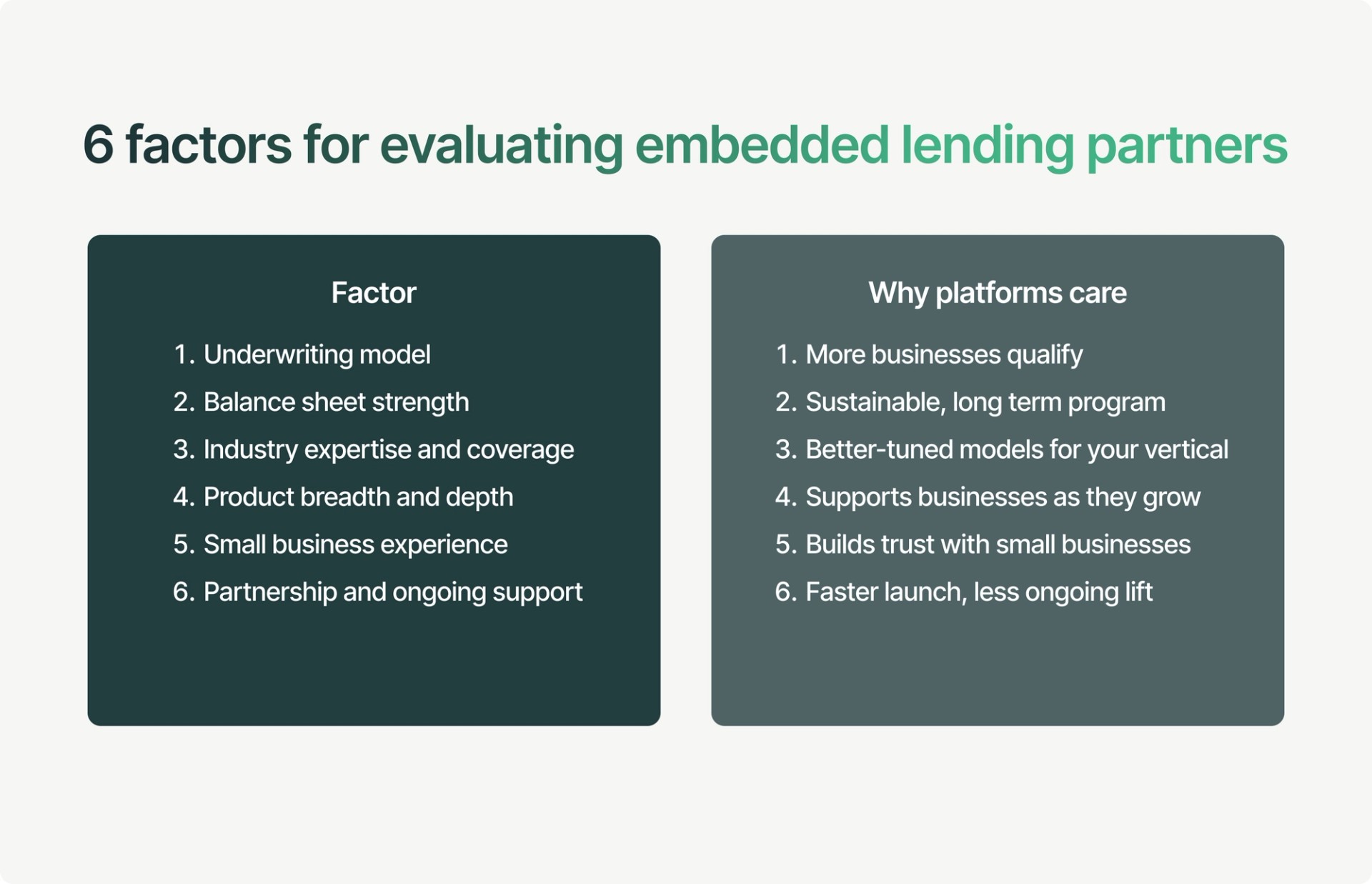
1. Underwriting model and history
The underwriting model determines which small businesses receive offers, how large those offers are, and what your portfolio loss rate looks like. It determines the potential of your program more than any other factor.
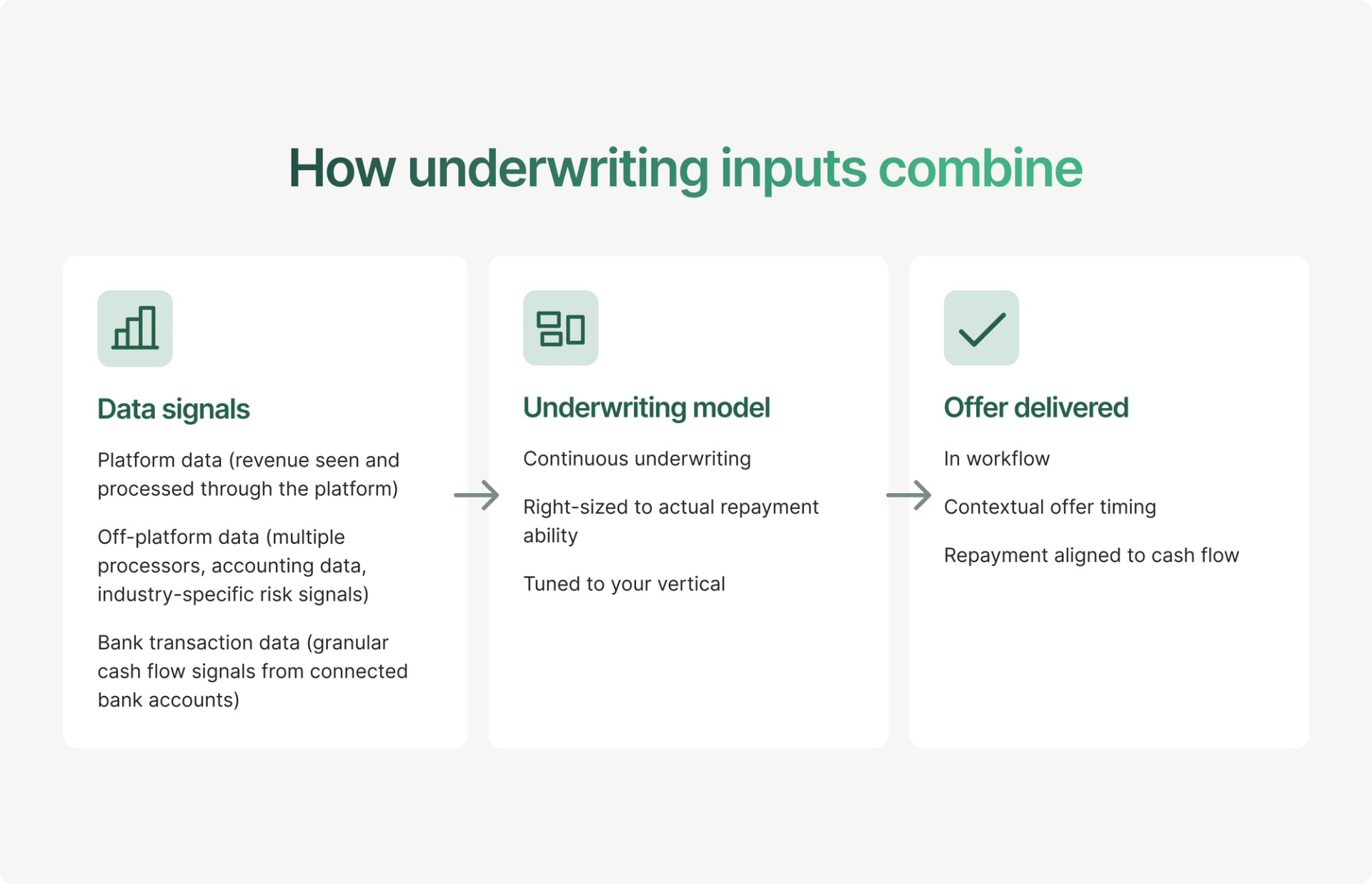
Platform sales data lets the provider size offers against actual revenue rather than proxies, which generally means larger offers without a proportional increase in losses, because the model understands how a small business actually performs.
The best models combine platform data with additional signals. Cash flow underwriting (using bank transaction data) and off-platform underwriting (using data from payment processors, accounting systems, and other sources) help providers evaluate businesses that may not qualify based on platform history alone, while improving accuracy across the broader portfolio.
Underwriting history is just as important. Over time, it becomes a powerful feedback loop that helps models get smarter, identifying the most compelling offer for a small business while maintaining a sustainable debt-to-revenue ratio.
What to ask
Request a sample underwriting run on your actual small business population before signing. This is the single most important pre-commitment step, and a credible partner will offer it proactively.
The harder part is comparing runs across providers. Eligibility and offer size are standard outputs that every embedded lender will produce, so two runs can look similar on the surface and behave very differently in production. Three things to push on:
- Right-sizing, not just sizing. The best partners use data beyond platform sales (cash flow, off-platform processors, accounting systems) to size offers a business can actually repay. Right-sizing is what drives repeat usage, where program economics compound.
- Real performance, not just projections. Ask for repeat rate, CSAT, NPS and how loss rates have held up across cohorts. A high repeat rate is the cleanest signal that underwriting and pricing are dialed in. A high loss rate on the other hand is a signal of an unsustainable program.
- Apples-to-apples pricing. Lower-priced offers convert at higher rates, so a partner can win a sample run on conversion alone. Hold pricing over a fixed duration constant when comparing eligibility, offer size, and projected revenue, then evaluate pricing separately.
2. Balance sheet strength
Every approved loan has to be funded, and every default has to be absorbed. The two questions that matter most are who absorbs the credit risk, and whether your partner has the financial durability to keep funding your program years from now.
Funding durability
Embedded capital is a long game. The provider you sign with today needs to still be operating, well-capitalized, and originating at scale in 5 years. Otherwise, your program stalls, your small businesses lose access to repeat capital, and you're back in the market looking for a replacement. Recent history has shown that providers can look healthy on the surface and run into trouble quickly when capital markets tighten or their funding model breaks down.
What separates durable providers from fragile ones is the depth and diversity of their capital markets relationships. Look for partners with established revolving debt facilities, forward flow agreements, and off-balance-sheet commitments from reputable lenders such as large banks. These structures signal that sophisticated capital partners have done diligence on the provider's underwriting and are willing to fund originations at scale. A provider that funds only from its own balance sheet, relies on a single capital source, or works with a capital source that isn't reputable is a concentration risk.
Risk structure
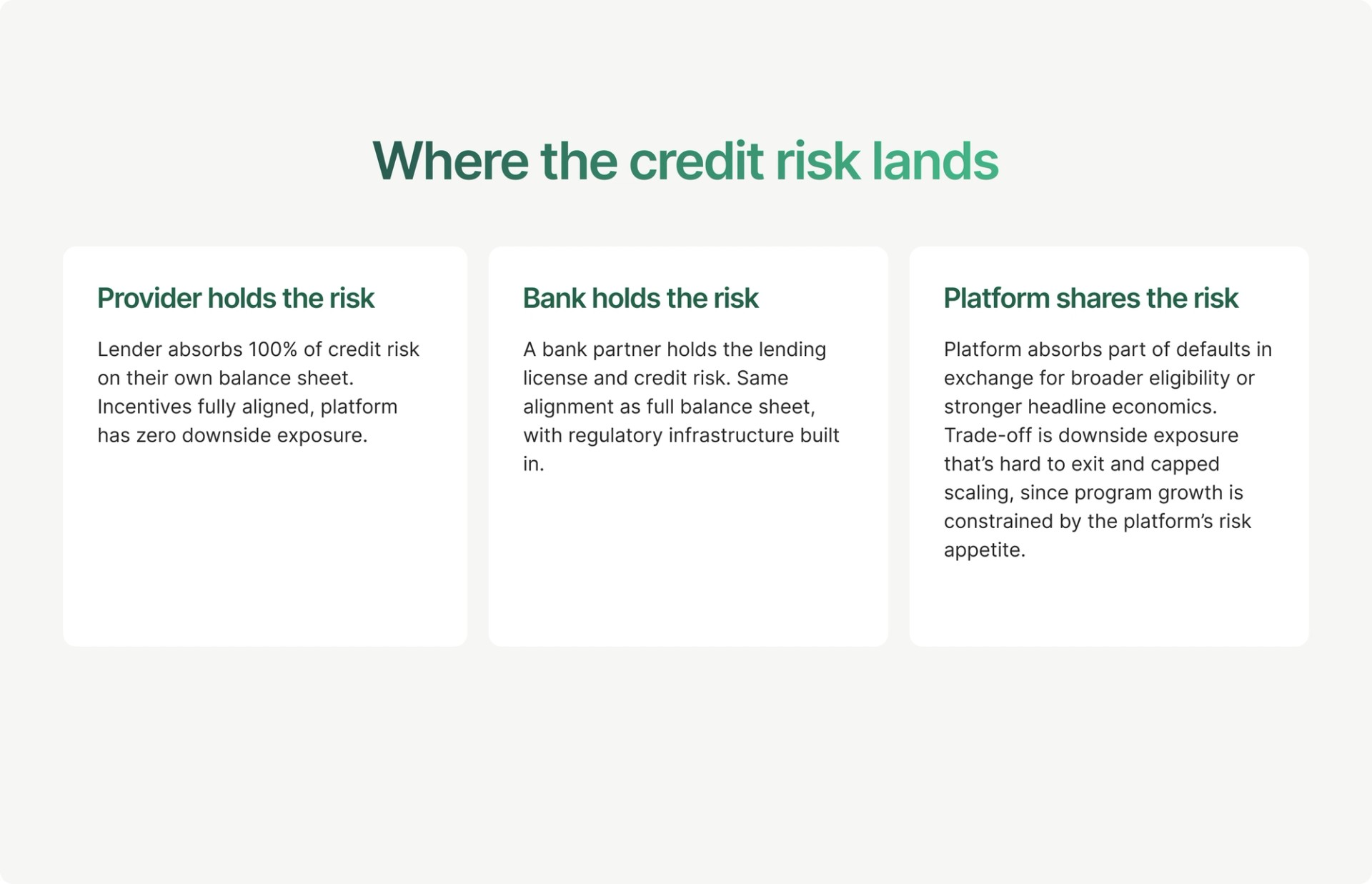
Most established embedded capital providers hold credit risk in full, either on their own balance sheet or through a bank partner, while the platform bears no credit risk or balance sheet exposure. This is the cleanest structure: when the lender bears full credit risk, they are fully incentivized to underwrite accurately, because they absorb the consequences.
Some providers will propose loss-share, guarantee, or co-investment arrangements that shift part of the credit risk onto the platform. These structures can unlock broader eligibility or stronger headline economics, but they introduce downside exposure that's hard to exit and tend to cap program scale, since growth gets constrained by the platform's risk appetite. Model your net position under a realistic default scenario before agreeing.
Pricing and cost of capital
Pricing flows directly from balance sheet strength. A provider's cost of capital (what they pay to fund originations) sets the floor on what they can charge your small businesses. Providers with diversified, institutional capital sources raise capital at materially lower rates than providers funding off their own balance sheet or relying on a single high-cost source, and that spread shows up in the offer your small business sees.
This matters because price is one of the largest drivers of acceptance. A provider with a structurally lower cost of capital can offer more competitive pricing without compressing unit economics, which compounds into higher conversion, more repeat usage, and stronger program revenue over time. A partner who can't speak clearly to their cost of capital, or whose funding costs haven't improved as they've scaled, is one whose pricing you should not assume is stable.
What to ask
- What does their capital stack look like, and what is their funding capacity?
- What is their cost of capital, and how has it trended as they've scaled?
- What debt facilities, forward flow agreements, or institutional commitments do they have in place, and with whom?
- How long is their current funding runway, and how have they performed through prior credit cycles?
- What do portfolio loss rates look like, both defaults and non-repayment?
- Do they require any loss guarantees or co-investment from you?
3. Industry expertise and coverage
Embedded capital programs are not generic. The signals that matter for food-and-beverage vertical SaaS look different from those that matter for field services or B2B marketplaces. What separates a strong partner from a weak one is depth of experience in your vertical and the scale of data they have to learn from.
Scale compounds. A provider that has underwritten small businesses at scale has seen how revenue patterns translate into repayment behavior across seasonality, macro cycles, and growth stages. That pattern recognition shows up directly in better offer accuracy and higher approval rates. A partner with active programs in your vertical, or a closely adjacent one, will have better-tuned models from day one. A partner with a large portfolio can put more aggregate dollars to work to run an experiment in order to test a hypothesis for your platform.
Geographic coverage is worth confirming early. Make sure the partner is thoughtful about regional regulatory requirements in the markets where your small businesses transact and prepared to navigate them as you expand into new regions.
What to ask
- What verticals does the partner have active programs in, and how many small businesses have they underwritten?
- Can they share reference customers in segments comparable to yours?
- Are they licensed in all the markets you operate in?
- How large is your existing portfolio and how many experimental dollars can you put to work?
How Parafin shows up across these factors
We have visibility into roughly 20% of the SMB economy through our platform partners, have funded billions of dollars to small businesses at industry leading loss rates and our team comprises of experts in data science and structured finance.¹ The combination of scale, plus operators who actually understand small businesses, is what shapes how we underwrite, how we right-size offers using data beyond platform sales, and how we show up for platforms over the long run.
4. Product breadth and depth
Your small business base is not uniform. Some need a few thousand dollars to cover a short gap, others need six figures to fund growth. A provider with a single boilerplate product will only serve a slice of your base, and the slice they miss is revenue and retention you leave on the table.
The right partner offers a range of products, repayment structures, durations, and underwriting methods (on-platform, off-platform, cash flow) so they can serve the full spectrum of your small businesses. The more they can fund, the more your platform sees in retention, GMV, and revenue.
What to ask
- What products do they offer, and what range of offer sizes and durations?
- What repayment structures are supported?
- What underwriting methods do they use to qualify businesses with limited platform history?
- What percentage of a typical platform's small business base ends up eligible across their full product suite?
- What product form factors are supported and how contextual can the lending product be?
5. Small business experience
Your small businesses will associate the capital experience with your platform, not with the embedded provider behind it. That makes it a brand decision as much as a product one.
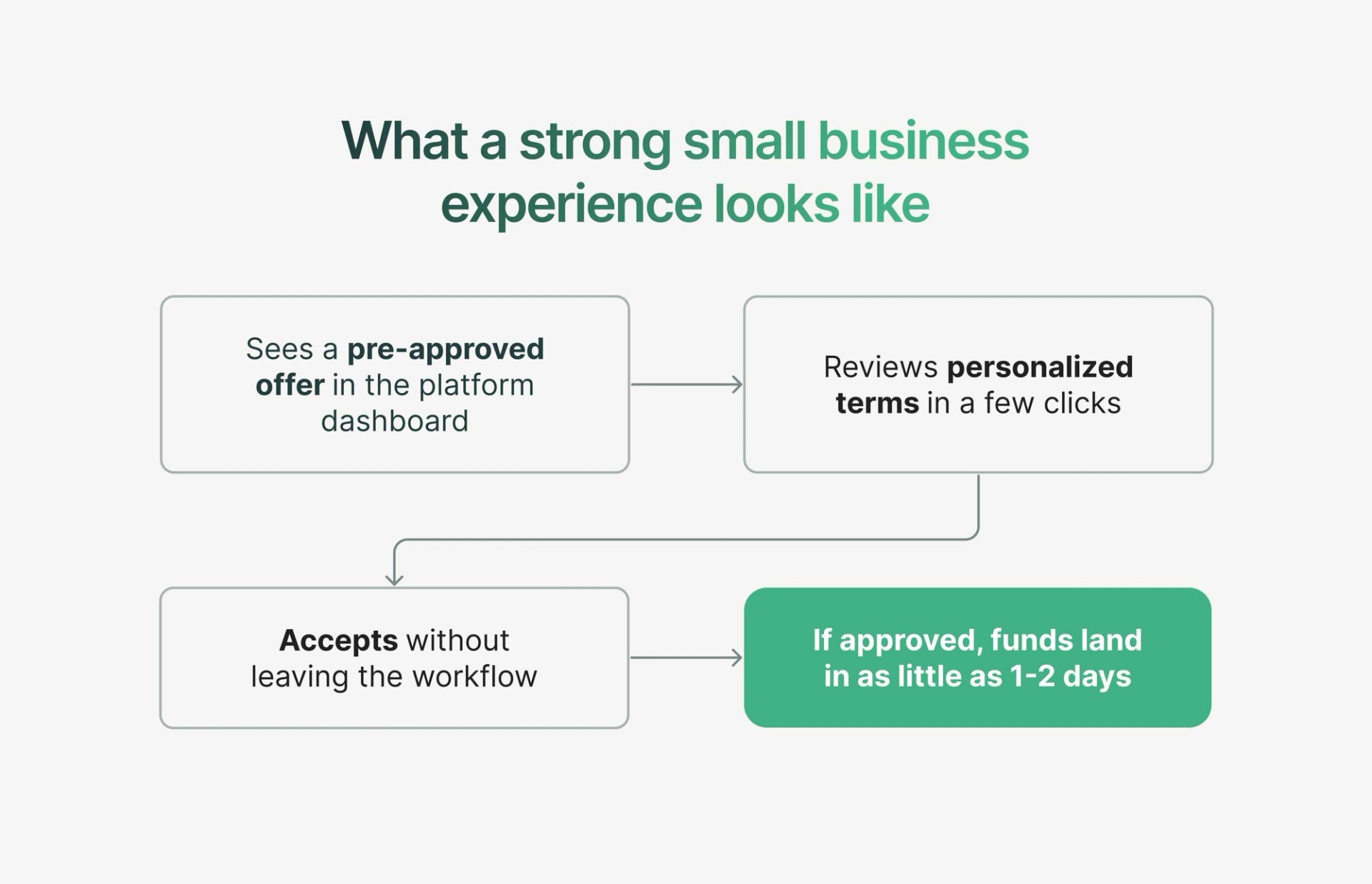
The experience needs to be frictionless, fast, and fair. The biggest driver of acceptance is whether the offer is pre-approved and personalized. When a small business sees their specific dollar amount embedded in your dashboard or app and can accept in a few clicks if approved, acceptance rates outperform generic application flows by a wide margin. Repeat capital depends on whether they felt treated well the first time.
What to ask
- Are offers pre-approved and personalized, and can they be embedded in your dashboard, emails, and mobile app?
- How quickly do funds land after acceptance?
- How are pricing and terms presented to the small business?
- Who handles questions and disputes, and at what SLA?
- What conversion rates do they typically see from offer view to acceptance?
6. Partnerships and ongoing support
Plenty of providers can sell you a fast integration. The harder question is what the relationship looks like once you're live, because an embedded capital program doesn't end at launch. It runs long term.
The right partner shows up with dedicated cross-functional resourcing during the build and keeps showing up after, with an account team that knows your business, engineers available when something needs to change, and a partnership that grows into new products, markets, and segments. The operational burden of running the program (underwriting, KYC, servicing, repayment infrastructure, lending compliance, support tickets) should sit with the partner, not the platform. Plenty of providers deliver documentation, complete the integration, and step back from there.
What to ask
- How does the partner think about origination and revenue potential today, and the trajectory you can build toward over 3-5 years?
- How does the partner handle expansion into new products, new markets, or new segments?
- What support do small businesses receive directly from the partner, and what gets routed back to your team?
- What does post-launch escalation look like when something breaks?
- Who are the existing marquee platforms they work with today?
The thread that runs through all six
These factors look independent, but they are connected. A strong underwriting model is only as good as the data feeding it. Platforms and small businesses supply that data, and that data is what lets the model learn, adapt, and get sharper with every cohort. A clean risk structure only matters if the partner can underwrite your small businesses in the first place. Strong APIs are wasted on a model that doesn't fit your vertical.
What separates programs that hit their goals from ones that drift is whether the partner is strong across all six factors, not just the one or two that show up in a pitch deck. Reference calls with comparable platforms tell you how a partner actually performs over time. A sample underwriting run on your own small business population tells you how their model actually works on your data. The strongest evaluations do both.
Ready to see what an embedded capital program could look like for your platform? Talk to our team.
¹ Reflects Parafin's share of US businesses with employees, based on sales data across its platform partner network. As of 2026.